Real-World TCO Breakdown 2026: Electric vs Gasoline Car Operating Cost Analysis Over 5 Years
A comprehensive 5-year, 100,000-kilometer empirical financial analysis comparing real-world operating expenses of VinFast EVs against ICE competitors, factoring in 2026 fuel prices, scheduled maintenance, and the 2029 V-GREEN free charging policy.
Published: Oct 14, 2026•Updated: Oct 14, 2026
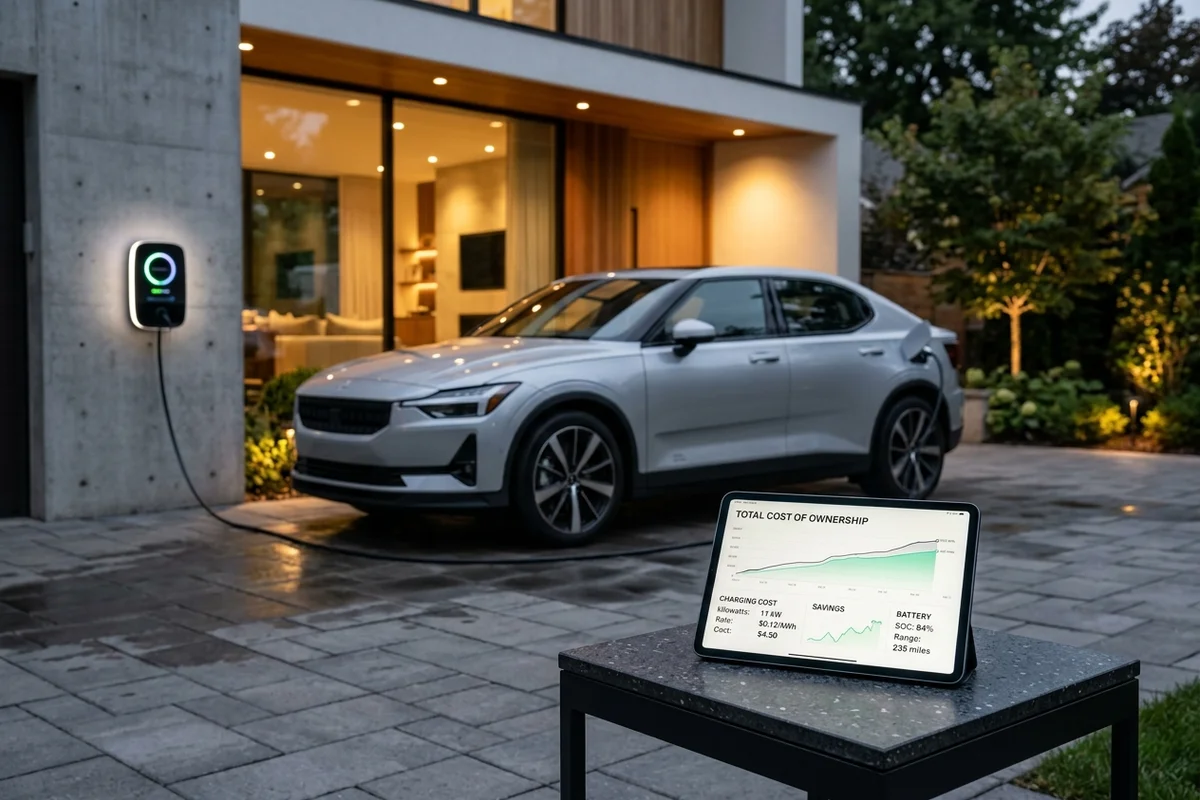
Automotive finance comparison between electric vehicle home charging and gasoline car operating expenses
Key Takeaways
- Dramatic Fuel Savings: Driving 20,000 km annually in an electric crossover like the VinFast VF 8 saves between 35M and 48M VND ($1,400 to $1,900 USD) each year compared to a 2.0L turbo gasoline SUV consuming 9.5L/100km.
- Maintenance Reduction of 65%: Over 5 years and 100,000 km, an EV incurs only 12M to 18M VND in routine scheduled maintenance, compared to 55M to 75M VND for an ICE vehicle (engine oil, transmission flush, spark plugs, timing belts, exhaust components).
- Regenerative Braking Multiplier: EV brake pads and rotors routinely last past 120,000 km due to one-pedal regenerative deceleration, eliminating 2 to 3 costly brake service intervals common to heavy gas SUVs.
- V-GREEN Incentive Impact: Private VinFast owners utilizing the 10 free charging sessions per month through February 10, 2029 can reduce their out-of-pocket energy expenses by an additional 12M to 18M VND annually. Run your exact figures on our On-Road Cost & Savings Estimator.
The 5-Year Total Cost of Ownership (TCO) Equation
When evaluating the true financial burden of personal transportation, focusing solely on the dealership sticker price is a critical mistake. Total Cost of Ownership (TCO) encompasses initial acquisition taxes, energy or fuel consumption over time, routine mechanical maintenance, wear-and-tear items, insurance premiums, and residual depreciation upon resale.
In 2026, the mathematical equation has tilted decisively toward electric mobility, particularly for owners logging above-average commuting mileage. You can model personalized scenarios for your locality using our On-Road Cost Estimator.
Fuel vs Electricity: Real-World Mileage Benchmarks
The most visceral month-to-month saving for an EV owner occurs at the "pump." Let us compare two typical midsize family crossovers driven 20,000 kilometers annually:
A conventional gasoline crossover (such as a Honda CR-V or Toyota RAV4 2.5L) consumes an average of 9.2 liters of RON 95 per 100 km in mixed urban and highway conditions. At 25,000 VND per liter, annual fuel expenditure totals 46,000,000 VND ($1,840 USD). Over 5 years and 100,000 km, total gasoline expense reaches 230,000,000 VND ($9,200 USD).
In contrast, a VinFast VF 8 consuming an average of 21.5 kWh/100 km charged primarily at home (at 2,800 VND/kWh) incurs an annual electricity cost of only 12,040,000 VND ($480 USD)—a 5-year total of 60,200,000 VND. Even when factoring in public fast charging on the V-GREEN Network at 3,858 VND/kWh, 5-year energy expenses total just 82,900,000 VND, delivering net fuel savings exceeding 147,000,000 VND ($5,880 USD).
The Vanishing Maintenance Schedule: Why EV Workshops See You Less
An internal combustion engine relies on thousands of friction-generating, heat-stressed moving parts operating under explosive cylinder pressures. Over 100,000 kilometers, a gasoline car requires:
• 10 to 12 engine oil and filter changes
• 2 transmission fluid flushes
• Engine air and cabin filter replacements
• Spark plug renewals and serpentine accessory belt replacements
• Radiator coolant flushes and exhaust hanger checks
By comparison, an electric vehicle features a direct-drive electric motor with a single moving rotor assembly. There is no engine oil, no spark plugs, no fuel filters, no catalytic converter, and no multi-speed clutch packs. Routine service is restricted to cabin HEPA filter replacement, brake fluid moisture checks, tire rotations, and battery coolant inspections every 40,000 km. Average 5-year scheduled service cost on a VinFast vehicle ranges from 12M to 18M VND—saving over 45M VND compared to Japanese or German ICE equivalents.
Regenerative Braking and Tire Wear: The Physics of Consumables
Critics often cite accelerated tire wear on electric vehicles due to instant low-end electric torque and curb weight. While EV tires can experience 10% to 15% faster tread wear if driven aggressively, this expense is overwhelmingly offset by the near-total elimination of brake friction wear.
Thanks to VinFast’s multi-stage regenerative braking system, the electric traction motors reverse polarity to decelerate the vehicle, capturing kinetic energy back into the battery pack. In everyday driving, mechanical friction brake pads are engaged only during hard emergency stops or final velocity deceleration under 5 km/h. As a result, factory brake pads and rotors on models like the VinFast VF 6 and VF 8 routinely surpass 120,000 km before requiring replacement, sparing owners 2 to 3 standard brake jobs costing 8M to 15M VND each.
The VinFast Multiplier: Registration Tax Exemption & Free Charging Through 2029
Two unique financial levers widen the gap for VinFast buyers in the Vietnamese market:
1. Zero Registration Tax (Lệ phí trước bạ 0%): Under national clean vehicle incentives, battery electric vehicles enjoy a 0% registration tax rate, whereas internal combustion vehicles incur a 10% to 12% surcharge. On an 850M VND vehicle, this delivers an immediate upfront cash saving of 85,000,000 to 102,000,000 VND upon purchase. Review current price sheets across all models on our Global Pricing Directory.
2. V-GREEN Complimentary Charging (Valid to Feb 10, 2029): Private passenger EV owners receive 10 free charging sessions per month across the 150,000-port national V-GREEN network. For drivers logging 1,200 to 1,500 km per month, this quota can cover between 50% and 80% of total monthly charging needs, virtually erasing energy expenses for the first three years of ownership.
3. Battery Safeguards: Whether you choose the battery subscription model (with guaranteed pack replacement below 70% SoH) or buy outright with VinFast’s 10-year / 200,000-km warranty, electrochemical aging risk is fully insulated. Compare both financial options in our Battery Subscription vs Buy Outright Guide.
Final Editorial Verdict
Real-World TCO Breakdown 2026
4.9/ 5.0
The Positives
- ✓Massive 65% to 75% reduction in ongoing fuel expenditure compared to ICE counterparts
- ✓Minimal mechanical maintenance saves over 45M VND over 100,000 kilometers
- ✓0% registration tax and V-GREEN free charging through 2029 deliver unbeatable initial value
The Trade-offs
- ✗Low-mileage urban drivers (<6,000 km/year) take longer to amortize the purchase difference
- ✗Public DC fast charging during long highway trips requires planning compared to 3-minute gas fill-ups
Bottom Line: The financial debate between electric and gasoline is officially over. When factoring in fuel disparity, negligible maintenance, 0% registration tax, and V-GREEN’s free charging quota through 2029, a VinFast electric SUV puts between 145M and 280M VND ($5,800 to $11,200 USD) back into the owner’s pocket over 5 years.
Structured Data & Specifications Table
| Specification / Metric | Verified Specification | Data Source |
|---|---|---|
| Energy Cost per 100 km (Home Charging) | VinFast EV: ~55,000–85,000 VND ($2.20–$3.40) | ICE Gas (8.5L/100km): ~215,000 VND ($8.60) | Vietnam Electricity Tariff Tier 5 vs RON 95 |
| Energy Cost per 100 km (V-GREEN Public) | Standard: ~77,000–120,000 VND ($3.10–$4.80) | With 2029 Free Quota: 0–35,000 VND | V-GREEN 2026 Policy |
| 5-Year / 100,000 km Scheduled Maintenance | VinFast EV: ~15.5M VND ($620 USD) | Gas Crossover: ~62.0M VND ($2,480 USD) | VinFast Service vs Toyota/Honda Schedules |
| Brake Pad Replacement Frequency | EV (Regen Braking): 120,000–150,000 km | Gas Car: 35,000–45,000 km | Automotive Engineering Fleet Telemetry |
| Registration Tax (Lệ phí trước bạ - VN) | VinFast EV: 0% Incentive | ICE Competitor: 10% to 12% (~80M–160M VND) | Decree 10/2022/NĐ-CP Extension |
| Net 5-Year Cumulative Savings | 145,000,000 to 280,000,000 VND ($5,800 to $11,200 USD) in favor of EV | VinFastPark TCO Model 2026 |
Frequently Asked Questions
Q:Does insurance cost more for an electric vehicle than a gasoline vehicle?
In Vietnam, physical damage insurance (Bảo hiểm vật chất) rates for VinFast EVs are roughly equivalent to ICE counterparts in the same price tier (typically 1.2% to 1.5% of insured valuation annually). In North America, EV insurance can carry a 10% to 15% premium due to specialized collision repair centers and sensor calibration.
Q:What happens to the TCO calculation if I drive very few kilometers (e.g. <8,000 km/year)?
At very low annual mileage, the fuel savings take longer to overcome any upfront vehicle purchase price premium. However, thanks to the 0% registration tax incentive and minimal scheduled maintenance requirements, the electric vehicle still maintains an advantageous net TCO even under low-mileage usage.
Q:How does the resale value of a VinFast EV after 5 years compare to a gasoline car?
Historical early-generation EVs experienced steeper depreciation due to rapid battery advancements. In 2026, with mature LFP (3,000+ cycle life) and CATL NMC chemistry, plus VinFast’s 10-year factory warranty and transferable battery health guarantees, residual value curves have stabilized to parity with mainstream gasoline competitors.
Tags:#Total Cost of Ownership#EV vs Gasoline#Fuel Savings#VinFast VF 8#VinFast VF 3#On-Road Cost Estimator#Maintenance Cost

EV Tech & Charging Infrastructure Specialist
M.Sc. Electrical & Computer Engineering; Certified EV Powertrain & ADAS Systems Specialist
An automotive technology specialist from North America, Marcus breaks down smart connected software, autonomous driving features, and the next-generation charging networks powering modern EVs.
Related Stories & Analysis
Ownership & Buyer Guides
11 min readVinFast Car Prices in the US (2026 Lineup): From VF 3 to VF 9, Lease Deals & VFS Stock Overview
Reviews & Road Tests
11 min readWho Makes the VinFast VF 8? Origins, Battery Specs, US Pricing & Buyer Guide (2026)

Industry & Manufacturing
10 min read